Steering Through the Storm: Paul’s Journey to Rome

Introduction: Surviving Life’s Storms with Faith
We all face storms in life. Plans fall apart, people betray us, and we’re left with the sinking feeling that we have no control. I’ve experienced these moments in my life, and I imagine many others have as well. That’s why I feel compelled to share my interpretation of the conclusion of Acts (27 and 28). Paul’s treacherous sea voyage through the Mediterranean is more than a historical event, it’s an example for how to endure life’s challenges when everything feels like it’s falling apart. His story gives us a blueprint for what it means to stay faithful to the mission God has placed within us.
Our lives are largely defined by how we respond in these kinds of moments. Although we may dread them, they can give us meaning and clarity. When the waves crash, we have a simple choice: rise or fall. If we remain steadfast in our faith and purpose, if we hold fast to the objective God has given us, we will see His promises fulfilled.
Who Was Paul Before the Storm? (Acts 7–9)
To understand Acts 27, we must first understand Paul. We first meet him as Saul, in Acts 7 as an opponent of Christ, he is present and pleased when Stephen, “…a man full of faith and the Holy Spirit”, is stoned to death for speaking truth about Abraham, and Moses. In short, Saul blind to the truth, and aligned with Pharisees. But in Acts 9, Saul encounters the Holy Spirit and is blinded by it, only to later regain his sight through divine intervention. From that point on (Acts 13:9), he becomes Paul and devotes himself to spreading the gospel of Jesus Christ throughout areas of modern-day Greece, Turkey, Cyprus, Jerusalem, and ultimately Rome. Along the way, he’s beaten, stoned, imprisoned, and left for dead, yet continues forward with conviction because he knows his calling.
God’s Mission for Paul: To Stand in Rome (Acts 23:11)
Acts 23:11 give us insight to Paul’s mission when it says: “The following night the Lord stood by him and said, ‘Take courage, for as you have testified about me at Jerusalem, so you must bear witness also at Rome.’” Keep this in mind with the following, Paul is a man on a mission, a mission from God. That’s what makes this journey even more incredible.
Paul has been held in Caesarea (modern-day Israel) under Roman custody for over two years, defending himself before Roman leaders like Festus, Felix, and King Agrippa. Eventually, he appeals to Caesar, which, as a Roman citizen, he has the right to do. This sets his course to Rome.
The Storm at Sea: Trusting God in Crisis (Acts 27)
Acts 27 begins with the decision to transport Paul to Italy under the care of a Roman centurion. Since the journey can’t be made in one trip, they have to stop along the way and change boats. After battling unfavorable winds and barely reaching Lasea on the southern coast of Crete, Paul advises them to stop for the winter and not continue sailing. “Sirs, I perceive that the voyage will be with injury and much loss, not only of the cargo and the ship, but also of our lives” (Acts 27:10). However, the centurion trusts the ship’s owner and captain instead. They set sail for Phoenix, further long the coast of Crete, hoping to make a better harbor.
Leadership in the Storm: Paul’s Unshaken Faith
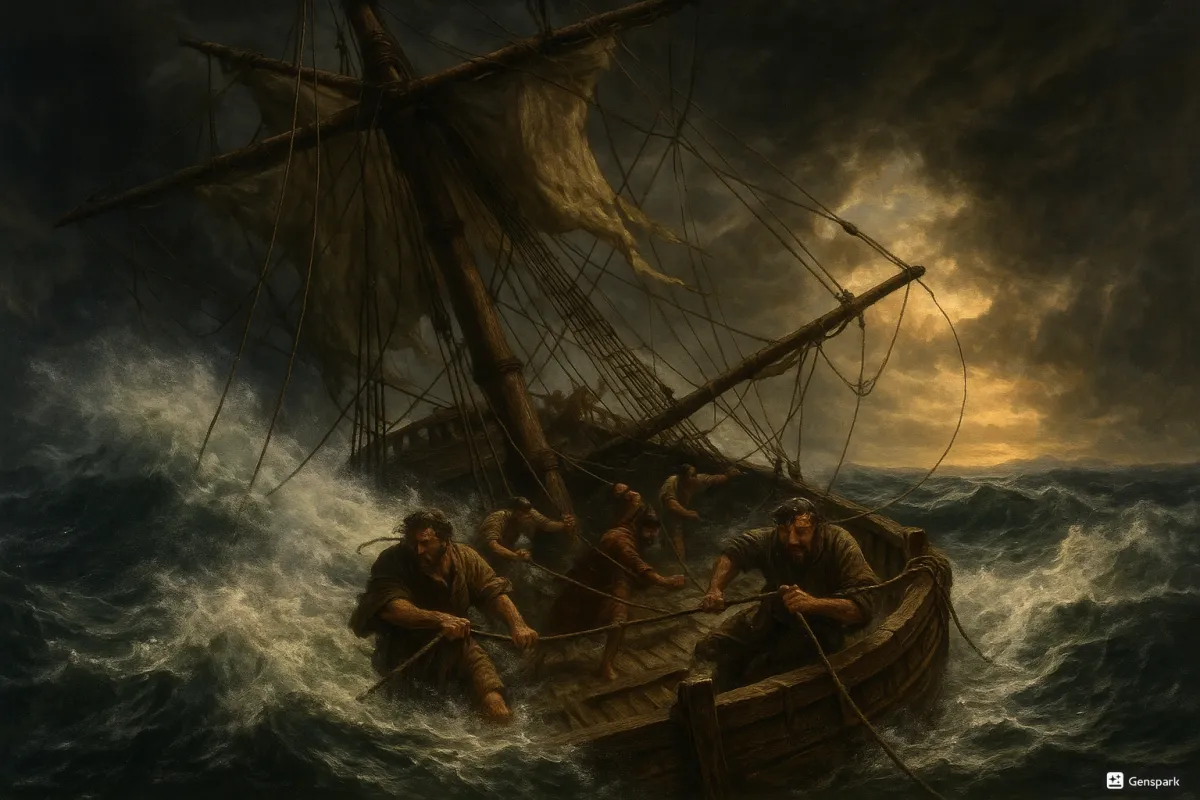
As Paul warned of, a violent storm “the Northeaster” descends on them. The crew is unable to navigate and drifts helplessly, they undergird the ship with ropes to keep it together and fear they’ll run aground on deadly sandbanks. They lower the gear and let the storm drive them. On the second day, they throw cargo overboard. On the third, they toss the ship’s gear. The storm blocks out the sun and stars—hope is lost (Acts 27:18–20).
This is the turning point, in the middle of this chaos, Paul rises. He tells the crew, “Men, you should have listened to me... Yet now I urge you to take heart, for there will be no loss of life among you, but only of the ship. For this very night there stood before me an angel of the God to whom I belong and whom I worship, and he said, ‘Do not be afraid, Paul; you must stand before Caesar. And behold, God has granted you all those who sail with you.’ So take heart, men, for I have faith in God that it will be exactly as I have been told” (Acts 27:21–25).
Paul is unshaken, not because the situation is in his favor, but because his faith is in the One who holds power over the wind and waves. He knows that his objective to testify in Rome has been ordained by God (Acts 23:11). No storm, no shipwreck, no opposition will prevent it.
Shipwreck and Survival: God's Promise Fulfilled
On the fourteenth night into the storm, “about midnight”, the sailors suspect land was near. They dropped a sounding line to test the depth of the waters and found it to be decreasing, proof enough for them that they’re approaching shore. In fear, they lower the lifeboat under the pretense of laying more anchors. But Paul saw through this and warns the centurion, “Unless these men stay in the ship, you cannot be saved” (Acts 27:31). The soldiers cut the ropes, trusting Paul over the ship’s leadership, they now understood that there is no escaping, only submitting to God’s will.

At dawn, Paul encourages everyone to eat, “Today is the fourteenth day that you have continued in suspense and without food... Therefore I urge you to take some food. For not a hair is to perish from the head of any of you” (Acts 27:33–34). He blesses the bread and eats, and the others follow. In that moment, a chain reaction occurring, 276 people found strength through one man’s faith. They then throw the remaining cargo into the sea to lighten the ship and press forward.
By mid-day, they spotted a beach and planned to bring the ship there, “so they cast off the anchors and left them in the sea, at the same time loosening the ropes that tied the rudders; then hoisting the foresail to the wind they made for the beach.” (Acts 27:40 ) But the boat strikes a sandbar and breaks apart. In the chaos, the soldiers plan to kill the prisoners to prevent escapes, but the centurion, wanting to save Paul, stops them. Those who can swim do so; the others float on debris. “And so it was that all escaped to land” (Acts 27:44).
Paul in Malta and the Fulfillment of His Mission (Acts 28:1–16)
Acts 28 picks up with their arrival on the island of Malta. The locals show unusual kindness, building a fire to warm them. As Paul gathers wood, a viper fastens itself onto his hand. The islanders assume he must be a murderer being punished, but when "he, however, shook off the creature into the fire and suffered no harm" (Acts 28:5), they change their minds and say that "he was a god" (Acts 28:6).
Paul then prays over Publius’s father who was sick with fever and dysentery and heals him. “And when this had taken place, the rest of the people on the island who had diseases also came and were cured.” (Acts 28:9). After three months, they set sail again, “And so they came to Rome.” (Acts 28:14), just as God promised (Acts 23:11).
Preaching Boldly in the Heart of the Empire (Acts 28:17–31)
In Rome, Paul is placed under house arrest but is granted freedom to receive visitors. He calls together the local Jewish leaders and shares with them the reason for his imprisonment, “it is because of the hope of Israel that I am bound with this chain.” (Acts 28:20).
He explains that he has done nothing against the people or customs of their fathers and appeals to them to hear his defense.
Some are convinced by what he says, others disbelieve. But Paul closes with, “The Holy Spirit was right in saying to your fathers through Isaiah the prophet: ‘Go to this people, and say, You will indeed hear but never understand, and you will indeed see but never perceive. For this people’s heart has grown dull, and their eyes have closed; lest they should perceive with their eyes, and hear with their ears, and understand with their heart, and turn for me to heal them.’ Let it be known to you then that thus salvation of God has been sent to the Gentiles; they will listen.” but salvation has been sent to the Gentiles; they will listen" (Acts 28:26–28).

He remains in Rome for two whole years at his own expense, “preaching the kingdom of God and teaching about the Lord Jesus Christ quite openly and unhindered” (Acts 28:31). He made it, not just to land, but to his destination: the very heart of the Roman Empire, where he preached the truth of Jesus Christ under Caesar Nero’s shadow.
Conclusion: Testify in the Storm and in the Stronghold
Paul’s story is not simply a dramatic account of a shipwreck and survival; it’s an allegory for our own walk through adversity. His journey reminds us that while we may not control the storm, we are always responsible for how we respond to it. He shows us what it means to stand firm in faith when the world around us is falling apart, to trust even when it’s not convenient.
The storm did not derail Paul, it refined him, Malta was not a mistake, it was a chance for him to spread the Word. Rome was not a coincidence, it was a calling. At each stage of his journey it required faith, faith to speak when no one listened, faith to lead when others panicked, and faith to keep going when everything else was breaking apart.
Our lives, like Paul’s, are defined in these moments. When the winds and tides rage, the path ahead is may seem uncertain, but the choice remains the same: rise or fall. If we cling to the mission God has placed within us, if we hold fast to our faith, if we live out that purpose, we will have reached that righteous objective, and then even the most violent storm will serve His plan.
Ask yourself:
What storm might you be going through or what’s one you’ve already been through? Did it or is it preparing you for something greater?
Why was it so important that Paul made it to Rome of all places?
Do you think you have the confidence to persevere and proclaim boldly if you were put in position too? What if it was at your workplace, among friends or family, community, or even your government?
I will likely build off of this post and go into relating topics, like details on the individuals involved here, and the connection to revelation. I hope you enjoyed!
